

The WP3AI-EFFECT Platform Design and Implementation team has released three major outcomes that bring us significantly closer to a unified, flexible, and test‑ready platform for AI services across Europe. Here’s an overview of what’s new and why it matters for the TEF ecosystem and beyond.
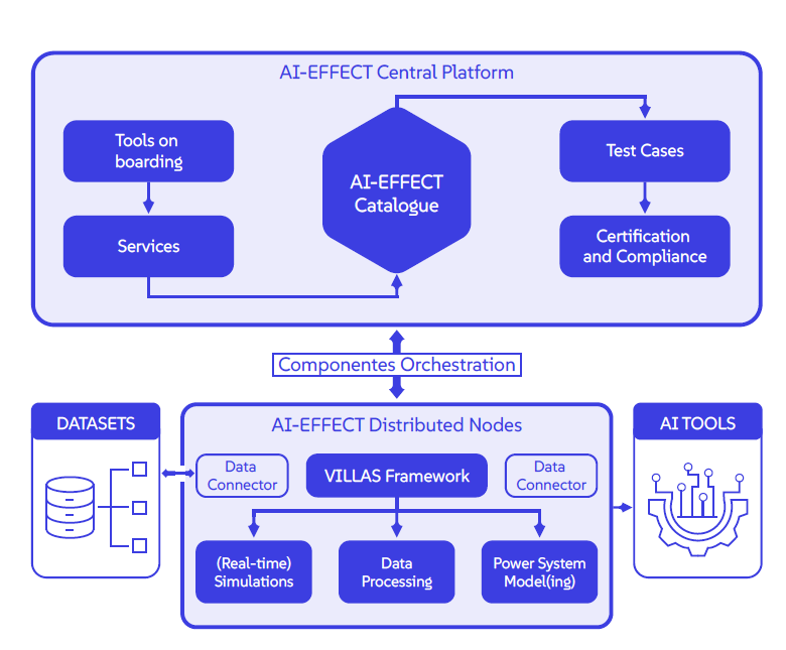
Platform Architecture Overview
📄 WP3 Platform Architecture Overview
This document provides the high‑level blueprint of the AI‑EFFECT platform. It explains how:
- Services developed by different partners plug into a common orchestrator
- Workflows are built and composed using the AI4EU Designer
- Modular design lets each service maintain full control over its implementation
- Cross‑partner interoperability is enabled by shared integration patterns
Why it matters:
This is the “big picture” that makes multi‑partner collaboration possible. By defining a clear, modular architecture, we enable workflows where independently developed AI components can be chained together, tested, and validated seamlessly. This is essential for scaling the Testing and Experimentation Facilities (TEFs) across domains.
Control Interface Specification
📄 WP3 Control Interface Specification
This is the technical contract that ensures every service can communicate with the orchestrator. It defines:
- Standardised control endpoints:
- /control/execute
- /control/status
- /control/output
- A universal DataReference format for passing data
- Supported communication protocols (file‑based, HTTP, S3, gRPC, MQTT, etc.)
- Implementation templates for both file‑based and gRPC‑based services
Why it matters:
This specification is the “glue” that keeps the ecosystem interoperable. No matter what technology stack a partner uses, the control interface ensures consistent execution, data exchange, and monitoring. This lowers the barrier for service integration and guarantees reproducibility, key for testing, validation, and certification workflows.
Code Release on Github
💻 https://github.com/IRESI-EU/ai-effect-wp3
The WP3 repository now includes:
- A working orchestrator implementation
- A file‑based energy pipeline example
- A protobuf/gRPC‑based energy pipeline example
- Ready‑to‑use service templates for developers
Why it matters:
This code is not theoretical—it’s runnable, inspectable, and extensible. Partners and developers can now prototype services quickly, test integrations, and build real pipelines that demonstrate how the architecture and control interface work in practice.
How This Fits Into the Bigger Picture of WP3
WP3 focuses on the design and implementation of the AI‑EFFECT platform, creating the environment where AI services can be tested, validated, integrated, and ultimately made ready for TEF‑level certification.
Within this work package, Task 3.2 is responsible for developing the orchestration mechanisms that allow AI service pipelines, including certification nodes, to be deployed and executed efficiently.
These new deliverables directly support that mission by providing:
- A shared architectural vision
- A standardised interface for service orchestration
- Practical, open‑source tools for implementation
Together, they form the core foundation needed to build a robust, interoperable, and EU‑wide AI testing ecosystem.
What’s Next?
With the architecture, specifications, and codebase in place, the next steps focus on expanding the range of services, integrating partner contributions, and demonstrating end‑to‑end workflows across application domains.
