

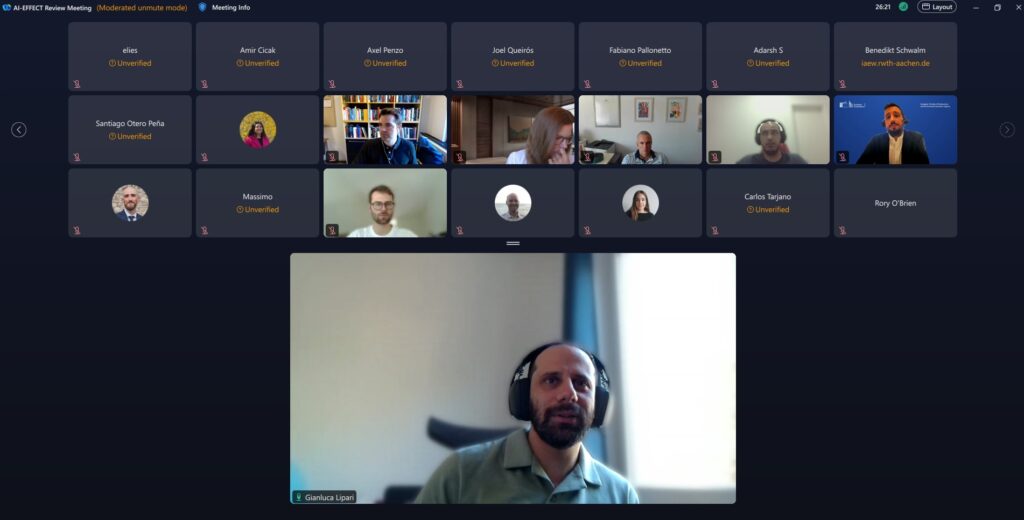
The AI-EFFECT project has successfully reached its midpoint, marked this week by an online project review with the European Commission and project partners. This milestone reflects an important moment in the development of a European Testing and Experimentation Facility (TEF) for Artificial Intelligence in the energy sector.
Over the first reporting period, the project has made significant strides in laying the foundations for a robust, scalable, and interoperable platform that will support the testing and validation of AI solutions across Europe’s energy systems.
Building the Foundations of a European AI TEF
A key achievement of this phase has been the definition of four strategic use cases across European nodes in Denmark, the Netherlands, Germany, and Portugal. These use cases address critical challenges in the energy sector, including congestion management, renewable integration, and energy efficiency, and are supported by dedicated testing methodologies.
In parallel, the consortium designed a modular and interoperable architecture for the AI-EFFECT TEF, aligned with European data space principles and built on secure, trust-aware foundations. This architecture forms the backbone for future platform deployment and integration activities.
Advancing AI Validation and Platform Development
AI-EFFECT has also delivered important technical components, including the development of open-source toolboxes for AI explainability and verification. These tools provide the capability to assess the performance, transparency, and reliability of AI solutions in energy applications.
Progress has also been made on the platform side, with initial development of AI service onboarding processes, orchestration mechanisms, and a dedicated web portal that will enable users to interact with TEF services and deploy AI solutions in a structured environment.
Putting Users and Impact at the Centre
Beyond technical developments, the project has taken a strong step towards ensuring user relevance and adoption. A human-centric Service Design methodology has been developed and applied, supporting the co-creation of future AI-enabled services based on stakeholder insights and real user needs.
Looking Ahead
With a solid foundation now in place, AI-EFFECT is moving into its next phase, which will focus on platform deployment, integration, and real-world validation of AI solutions across the energy value chain.
The consortium remains committed to contributing to Europe’s AI ambitions by enabling trustworthy, scalable, and impactful AI applications in the energy sector.
