

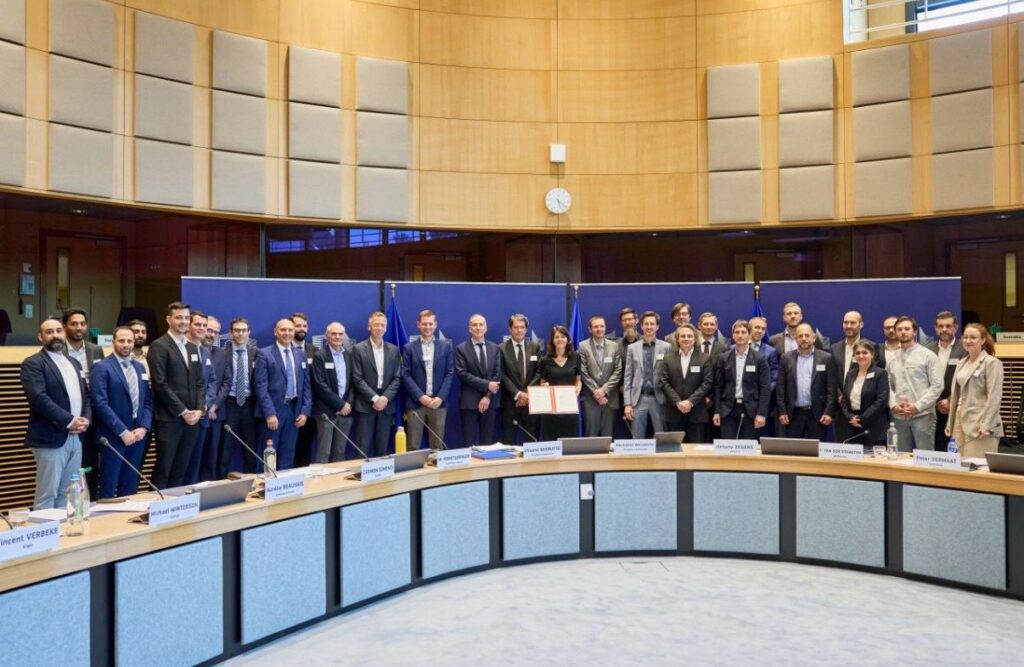
Europe took a pivotal step toward homegrown artificial intelligence for its energy networks on 3 June 2026. At a formal signing in Brussels , just after the European Commission unveiled its Strategic Roadmap for Digitalisation and AI in Energy 48 organisations pledged to a new collaboration AI.grids with one shared aim: to build sovereign, pan-European AI foundation models for managing energy grids. Representing AI-EFFECT at the event was project coordinator Gianluca Lipari.
For AI-EFFECT, the moment carried real significance. The project exists to accelerate trustworthy, open AI for Europe’s energy sector, so an initiative devoted to a shared, publicly minded foundation model felt like a natural extension of its own work.
Why AI.grids Matters
Running a modern grid is more complex than ever. Renewables, electrification, EVs, heat pumps and data centres are all reshaping how electricity flows, forcing operators to juggle millions of assets and constant uncertainty. Meanwhile, the sheer volume of data these systems produce outstrips what conventional, single-purpose tools can handle.
No ready-made commercial solution currently meets this need. AI.grids aims to address that gap before proprietary systems dominate an area where public interest, transparency and interoperability are essential. Drawing on advances in large-scale AI, the initiative proposes a flexible foundation model trained on diverse grid datasets to support applications such as forecasting, congestion management, asset monitoring and long-term planning.
European AI Collaboration
The agreement binds 48 signatories across four groups: 18 transmission and distribution operators ,22 research institutions, 5 industry firms, and 3 NGOs and intergovernmental bodies. Together they will develop the model, tap diverse European datasets, enable secure data sharing under the Common European Energy Data Space, and train at scale using the EuroHPC AI Factories.
Three principles anchor the effort: keep it open, keep it open-source, and pool the strengths of researchers, operators and manufacturers alike.
The partnership grew out of an open call by DG ENER and a Brussels workshop that drew more than 100 stakeholders, with the CRESYM research association handling its legal backbone. Further signing rounds are planned through 2026, and Horizon Europe proposals will extend the work into 2027.
Looking ahead
By early 2027, the initiative aims to deliver its first open-source Minimum Viable Product, marking an important step toward making advanced AI tools more accessible and interoperable across all 27 EU Member States. The model is expected to help reduce the cost and complexity of adapting AI to different grid environments, while supporting more consistent approaches to forecasting, planning and real-time system management. As the initiative’s governance framework continues to take shape, AI-EFFECT is proud to support a shared European vision for open, trustworthy and sovereign AI that can strengthen the resilience, flexibility and intelligence of the energy system.
